Why we Slide Back into Burnout
Apr 17, 2026
I like to think of burnout as a transformation, a metamorphosis, a portal into a new kind of life. If we fight it, or resist it, it can feel truly terrible. But if we allow it to do the transforming work it came here to do, it can change all of us for the better. We can become people we didn’t even know we could be, before we knew the reality of burnout. This doesn’t negate the pain. It allows the pain to work on us and change us, leaving us richer and fuller for the experience.
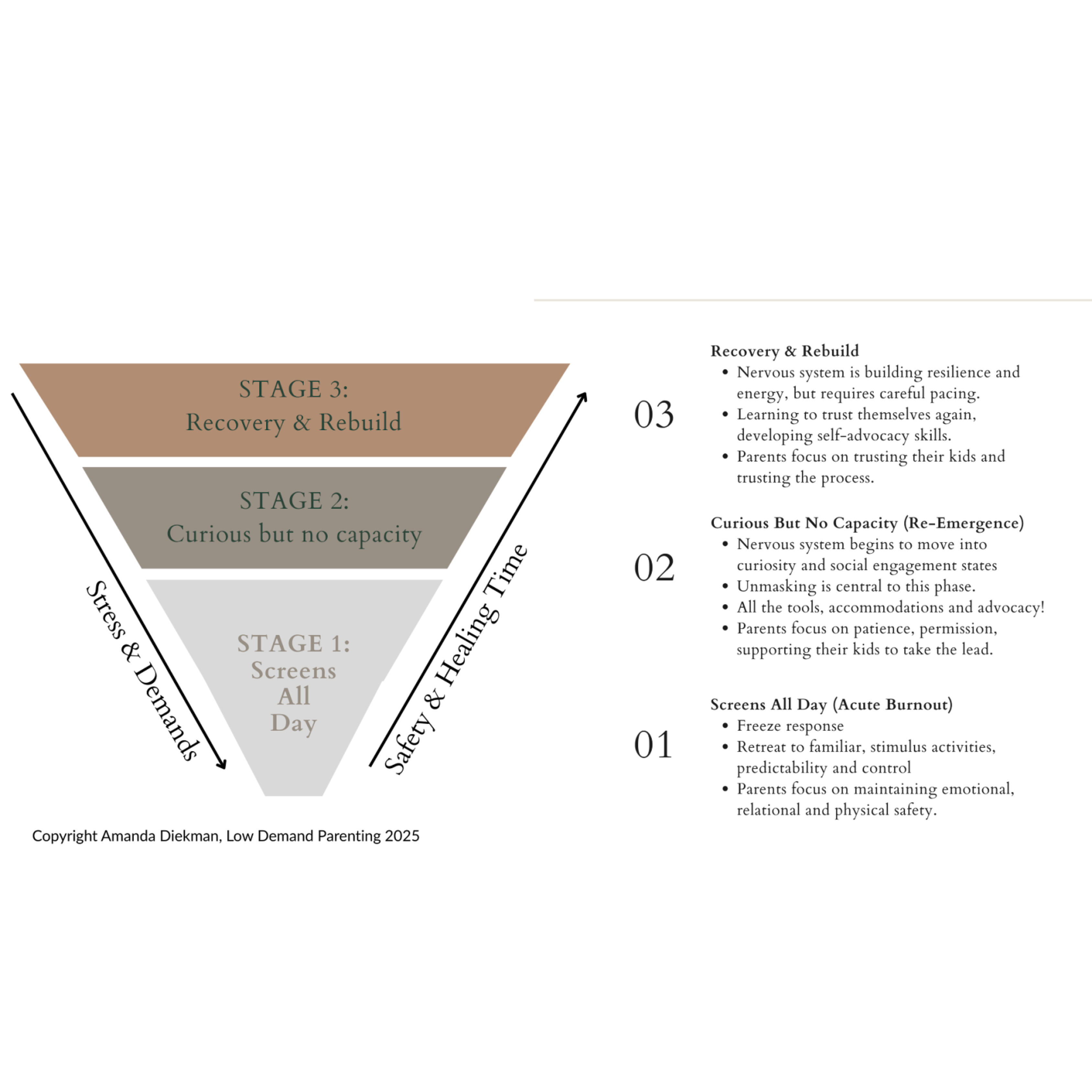
The three phases of burnout
In my professional work with hundreds of families, I’ve observed a distinct pattern to the evolution of burnout. Burnout has 3 unique phases, a framework that I discerned, named, and created myself. In burnout, it is as though your child, teen, or young adult is a caterpillar who has crawled into their crystallis, dissolved into goo, and is now on their journey toward becoming a butterfly. Burnout is a portal of transformation. The caterpillar-to-butterfly transformation metaphor helps us understand these phases, to figure out where your child is, and also to discern what might be coming next.
You get to treat this like a pattern map, not hard science. Your kid may be hovering between 1 and 2, seemingly stuck there. That happens. Your kid may be clearly in phase 2 in some areas (like socializing and communication), but already leaping into phase 3 in body care, sleep, and food. That absolutely happens too.
When burnout is prolonged (or they slide backward)
When a person is remaining in phase 1 or phase 2 of burnout for a prolonged period of time, (often more than 1 year in phase 1), there are a set of underlying risk factors that might be making your kid’s nervous system chronically unstable (and thus not able to move into phases 2& 3). These factors can also help make sense of why your kid has slid backward into an earlier phase, despite having made progress.
There’s always a good reason for your kid’s behavior and needs. Growth isn’t necessarily linear. We all heal at different rates and in different ways.
It is very common to make major discoveries about your kid through the lens of burnout. Things you just didn’t know before. And that’s ok! (Most of us feel guilty for not knowing sooner, for not getting testing and evaluation done sooner. So that guilt and self-blame is common too). Most of us don’t find out the layers of challenges that contributed to burnout until we’re already in it.
Reasons for burnout-regression:
1. Too much, too soon:
- A return to full-time schooling, or removing critical supports too soon can send a kid tumbling back into phase 1 again, even after they made progress and moved into phase 2. This can prolong the entire burnout cycle.
- Unavoidable life circumstances and transitions (losing a beloved caregiver, a move from one classroom to another, moving houses) overwhelmed your child’s system and prolonged their healing. This is not your fault; you’re not doing it wrong. It’s just that we heal at the pace of our nervous systems, and when they don’t feel safe and stable, healing takes longer.
2. Mental health:
- Unrecognized mental health challenges such as OCD or Bipolar may require specialized medication or treatment to bring your kid into stability, so that they can access tools and adapt to the lifestyle changes that are critical to burnout recovery. When our brain is on fire, sometimes only medication can bring enough stability to truly heal.
- C-PTSD: Ongoing abuse or exposure to trauma triggers may be prolonging the person’s recovery. Note that trauma research teaches us that it is not only large-scale events that lead to PTSD; the daily routines of school itself can be deeply traumatizing for many kids (sensory exposures like a crowded and smelly lunchroom, uncomfortable uniform, or being touched in the hallway). You may need to address their school trauma before they can feel safe in any learning environment again.
- Teasing, bullying, abuse, and social disconnection
- Larger forces of systemic discrimination like racism, sexism, being Queer or living in a Queer family, experiencing financial instability and poverty, anti-immigrant discrimination, anti-semitism, Islamophobia, and other forms of religious discrimination, and more.
3. Undiagnosed neurodivergence:
For many families, they don’t take their kid for a comprehensive neuro-psychological evaluation until they are already in the depths of burnout (which also, hats off to all of us who have done that; it’s a hard time to do a big eval!!). It’s only in burnout that you discover that they are ADHD (often the inattentive type and girls generally slip through the cracks), or that they have autism (and that autism doesn’t look anything like you thought it did).
Since these neurodivergent identities are primarily inherited, many of you will have also discovered that you’re neurodivergent too, or your spouse, or your parents—or most commonly, D. All of the Above.
- Autism
- ADHD
- PDA
- Giftedness
- Tourette’s
- Sensory Processing Disorder (including auditory processing disorders, like Misophonia)
- Learning disabilities (dyslexia, dysgraphia, dyscalcula)
- FASD
4. Physical health:
This category is so important and misunderstood. There may be dietary or gut imbalances. I've known children who, through their burnout period, figured out that they had severe food or environmental allergies or that they had been exposed to neurotoxins or inflammogens from living in a house with water damage or going to a school with mold. Some kids develop a chronic reaction to illness like PANS/ PANDAS, a class of neuropsychiatric conditions that lead to tics, OCD, severe anxiety and eating restrictions, seemingly overnight. Your kid might not be able to identify or name the physical challenges they are having, so they are simply showing up as dysregulation, aggression, or overall instability.
Here are possible triggers for re-entering phase 1 related to physical health:
- Dietary and gut imbalances (undiagnosed food allergies and intolerance, leaky gut, extreme vitamin deficiency, anemia)
- Exposures to neurotoxins, allergens, inflammagens, like Chronic Inflammatory Response Syndrome (CIRS)
- Chronic reaction illness, like PANS/PANDAS, Long COVID
- Autoimmune conditions and dysautonomia (Celiac, MCAS, POTS, Ehler’s Danlos)
- Rheumatic conditions (Rheumatoid arthritis, Lupus, psoriatic arthritis)
- Sleep challenges - delayed sleep onset, non-24 and other circadian rhythm differences, nightmares, sleep apnea, insomnia and night-waking, restless sleep disorders
- Migraines, headaches, pain
How compounding variables work
I’ve heard many medical professionals call this “the perfect storm.” Each person’s body has a threshold, a capacity-limit on what it can handle. There’s no way to look from the outside and figure out what a person’s capacity is. It’s an internal, slightly mysterious logic. Why does one kid manage their parents’ divorce, a rough year in school, three afterschool sports, and an anxiety diagnosis, but still be relatively fine? When another kid slides into burnout when the family pet dies—and seemingly little else?
First of all, many of our compounding variables are completely invisible. They can be literally invisible like hidden mold behind the walls of your kid’s school that is impacting overall inflammation and brain processing in ways that you could never see or prove. It can be invisible to you now—like undiagnosed learning disabilities, unmedicated ADHD, unnamed misophonia, undiscovered allergies.
It can also be invisible stressors that the child doesn’t even know to name, like how the school uniform makes them feel claustrophobic, or the fact that their sibling’s snoring is keeping them awake at night.
We often only find out these specific variables for our specific kid after they are already in burnout (or when they return to burnout again, way too soon). There’s a detangling process of figuring out all the large and tiny things that were too hard, the reasons our kid’s body crossed its threshold.
What’s happening in the body?
The central axis in our body that regulates our stress response is called the HPA axis. It’s actually the intersection of three different body systems, three ways the body mobilizes and responds to stress. When you've been in chronic stress for an extended period of time, it leads that whole HPA system to weaken and then shut down. Cortisol is constantly being produced and flooding through the body, which leads to a cascade of impacts (increased appetite, digestive issues, memory loss, challenges with focus and attention, poor quality sleep).
As the overall HPA axis weakens, energy levels surge and plummet; the immune system weakens, making it harder to fight off infections and creating an opening for auto-immune conditions. Due to changes in brain functioning, emotional exhaustion, executive functioning loss, and skill loss becomes prevalent.
Like a flickering light bulb right before it burns out completely, the nervous system starts bouncing between two states, either hyper-aroused, “all systems go”, super big response— or total freeze and shutdown. The nervous system loses the capacity to access moderation, to see “gray areas,” and effectively becomes a black-or-white reactive system.
Burnout really is a full-body reality, with the brain, nervous system, and every bodily system impacted. Sometimes it just takes one kid longer than another to fully heal and regulate this part of their central nervous system. It doesn’t mean you’re doing anything wrong. It means your child is more sensitive and has a more vulnerable system.
Recovery looks different for every kid and every family.
For some kids, recovery will mean extensive rest—lying on the couch watching the same show over and over. For others, it might involve deep dives into a special interest or the comfort of a highly repetitive activity. Some kids will maintain strict routines or cling to specific foods, while others may surprise you with new rituals that feel completely out of the blue.
The kid who comes out isn’t the same as the one who went in.
Often, the kid who emerges from burnout doesn’t look very much like the one who went in. So there’s grief in the journey too.
What matters is that you give them the space to do what they need without judgment. Recovery isn’t linear, and it’s not one-size-fits-all. It’s unique, specific, and customized to your kid. And importantly, your kid needs to take the lead. Finding their agency and power is a key piece of their overall healing.
Ready to dive deeper into understanding burnout?
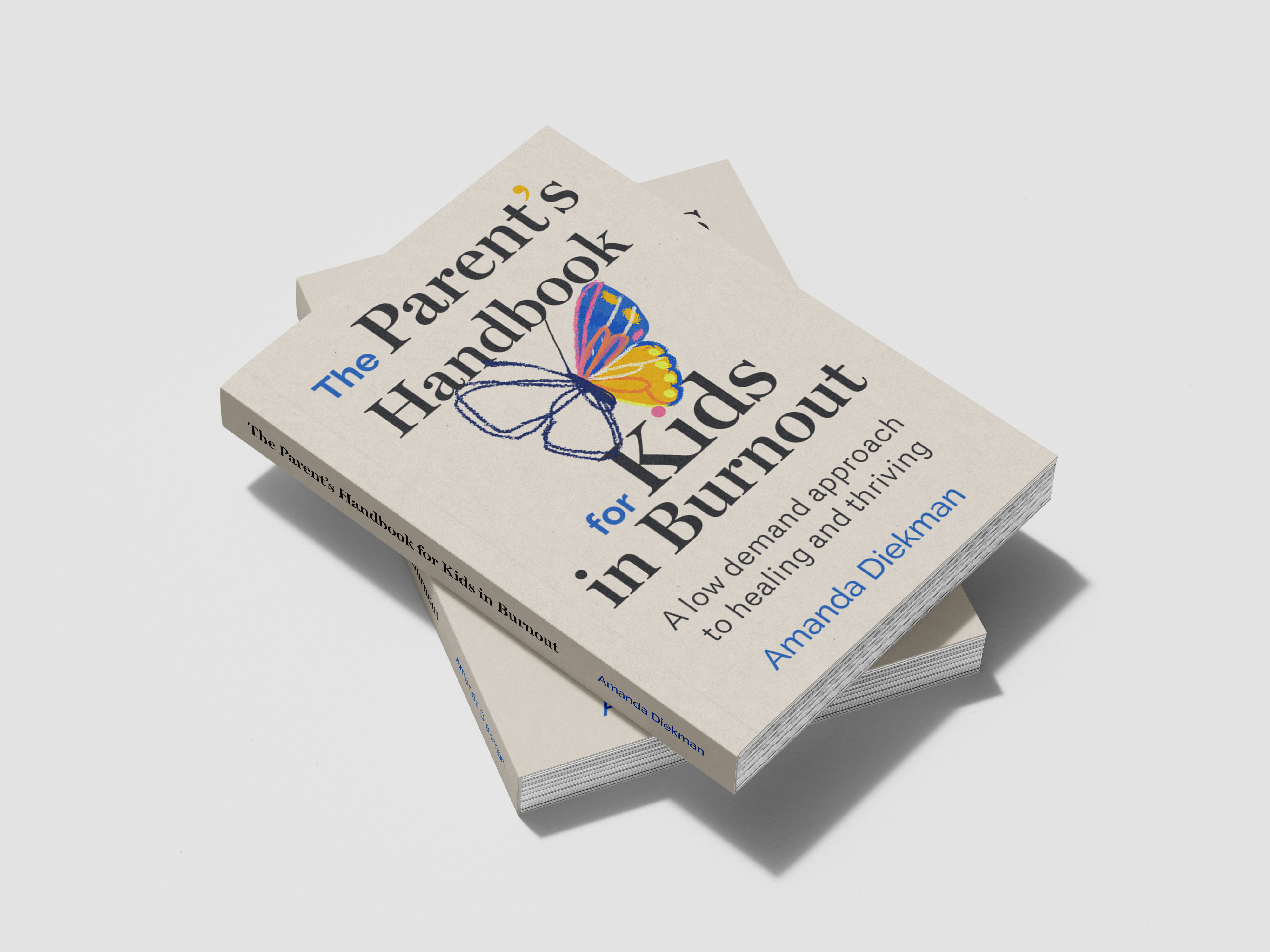 My newest book is here to help!
The Parent's Handbook for Kids in Burnout is a practical, research-driven resource to help you identify sources of stress and respond with compassion, while continuing to support your child’s growth and thriving.
With chapters to meet you wherever you’re at, this comprehensive handbook comes with a burnout assessment quiz, downloadable tools and charts, and dozens of practical stories and examples. Get the answers you need right away with chapters on showering, sleep, screens, school, meds, therapies, meltdowns, and mental health emergencies.
Quiz: "Why is everything so hard?"
................
Get your quiz results and discover one concrete next low-demand step toward ease and joy.
Low Demand in your Inbox
Juicy weekly emails include real-life parenting stories, low-demand ideas and tips, plus a collection of my favorite resources. A goodie-box of an email.
We hate SPAM. We will never sell your information, for any reason.