PTSD: It happens to parents.
Apr 25, 2026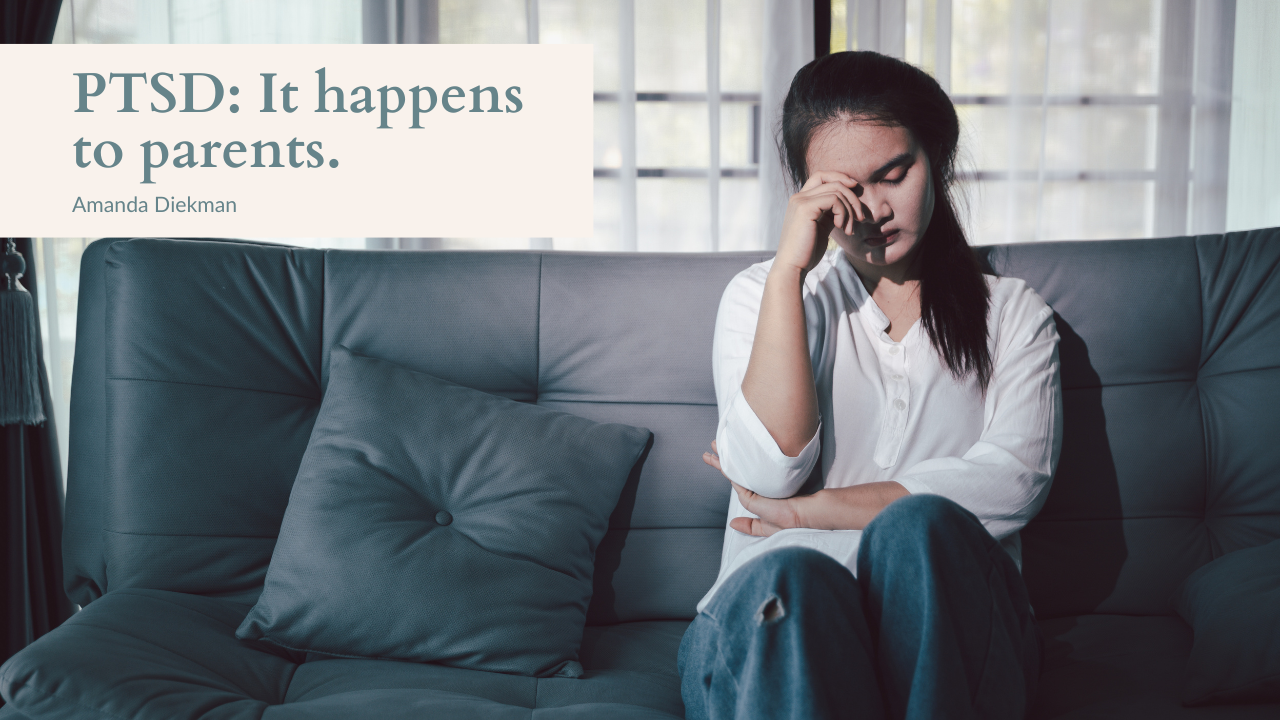
As a collective, we are slowly discovering that trauma is not only about singular, catastrophic events; trauma is about emotional and psychological wounds that are left untreated. According to trauma researcher Peter A. Levine, “Trauma is not what happens to us, but what we hold inside in the absence of an empathetic witness.”
My breaking point
12 months later, I was diagnosed with PTSD. It took me over a year to acknowledge that my daily anxiety and distress, my nightmares and restlessness, my racing thoughts and chronic exhaustion, were the result of trauma. It was one year later, almost to the day, before someone used the words “post traumatic stress disorder.” One year in which everything I thought I knew about parenting fell apart. One year in which everything changed.
Trauma researchers agree that small moments, laden with stress and despair, can indeed be traumatizing. They can contribute to a cumulative trauma that affects both parent and child. Each incident of screaming, resisting, and feeling utterly alone and misunderstood compounds the sense of helplessness. These experiences activate the body’s stress response, leading to an emotional state of terror, and a physical state of chronic hyper-vigilance in the nervous system. Over time, this chronic trauma can lead to symptoms like anxiety, depression, and even physical ailments as the body remains in a state of heightened alert.
We are ignored.
Most parenting books, coaches, and approaches either ignore the psychological state of the parent entirely—or worse, blame and shame them for struggling. We are told to “stay calm,” to “co-regulate,” to “be the bigger person”—without ever acknowledging how impossibly hard that is when your child is screaming, throwing punches, threatening themselves with knives, or smashing holes in the wall. The deeper truth is that millions of parents are barely holding it together. We are suffering. We are traumatized. We are ashamed. And we are doing it silently, because there is no space in the current parenting culture for our pain to be named as real.
But my pain was very, very real. At my lowest point, my symptoms were elevated to a level that I needed intensive intervention. I strongly considered in-patient facilities. There were days that I spent hours fantasizing about going to the hospital, staring at overhead fluorescent lights, having doctors fuss over me, and simply leaving the agony I was experiencing behind.
My hands shook every time my child yelled. I felt like I was hovering over myself, looking down at me. My body felt swollen and foreign, like it did not belong to me. My brain went silent, simply buzzing like bees were trapped inside my mind, blocking out all other thought and sound. Hours slipped by without me realizing it. Other times existing through a single moment felt like it took ages. I sweated at night, soaking my clothes and my sheets. I woke myself up shouting. I drank beers at noon to calm the panic symptoms.
What parenting trauma looks and feels like
It may be difficult at first to claim the label of “trauma” for yourself. It feels too big, too significant, for the series of tiny cracks that run through your exhausted heart. But perhaps a list of common symptoms would help. As you read this list, do you recognize any of your own hidden realities?
- Racing thoughts, persistent worry and tension, the feeling that you can never let up or drop your attention or else something terrible will happen
- A sense of emptiness, inability to remember what you enjoy doing or what feels good to you. Malaise, hopelessness, sadness. Like you’re in “the pit.” Like you can’t remember what you like to do or who you are anymore outside of your children. Inability to get out of bed or to feel any hope for the day ahead.
- Being constantly on edge, “walking on eggshells,” always anticipating the next crisis or meltdown. Creating worst-case scenario plans, and back-up plans for your back-up plans.
- Reliving pr replaying stressful events, often triggered by specific situations or reminders.
- Numbness, blankness, difficulty feeling your emotions or feeling connecting with others, including your spouse, friends, and your own children. A feeling that you don’t even like your kids anymore.
- Insomnia, frequent waking, nightmares, night sweats, grinding your teeth, waking exhausted.
- Chronic pain, headaches, gastrointestinal issues, heavy periods or not cycling at all.
- Difficulty eating, or binge eating. Using alcohol or other substances to cope.
- Mood swings, frustration, simmering rage, sudden and unexpected outbursts of anger.
- Shaking hands, racing heart, sweats, nausea, dizziness.
- Persistent feelings of guilt over perceived failures as a parent and shame about your child's behavior. An unshakeable sense that this is your fault, and that you will be shamed if you ask for help or share what is really going on.
- Withdrawing from friends, family, and social activities due to the demands of parenting and fear of judgment.
- Problems with focus and memory, often referred to as "brain fog."
- Avoiding places, people, or activities that might trigger stress or memories of traumatic events.
- A sense of being overwhelmed and powerless to change the situation.
- A feeling that you are not a real person anymore, just a shell of a human. Zoning out and losing time. A feeling of being outside yourself, watching yourself.
Perhaps you read this list and are thinking, “My experience is not nearly as bad as hers,” and that you don’t deserve a similar level of support because you haven’t suffered enough.
My friend: We do not need to be the same. My goal in writing about and sharing my experience is actually to restore your own knowing, your unshakable confidence that you have been right all along. Yes, your parenting journey has been beyond painful. Yes, it may have even included trauma. Yes, in fact, it may even be legitimately, capital-T Traumatic.
Researchers have found that the most important buffering factor for the wounding of trauma, and the singular key to healing, is connection. I continue to tell this truth so that you don’t feel so alone. Somewhere in the world, there is me, a real human writing this at 6am on my screen porch, reliving my worst parenting moments in an effort to fling love and connection into the cosmos. Wherever you are, whoever you are, I want you to know that what you’ve lived through is real. It is real trauma. You deserve this label because your suffering is valid, and your healing is powerful. And you are not alone with this isolating parenting experience. I have lived this too, and so have hundreds, thousands, likely millions, of others.
What felt like it was your singular shame is in fact our collective suffering, and by getting loud and open about it, we might actually change the systemic factors that led us here in the first place. Healing is not only needed on the individual and family level. Healing is needed in communities, systems, and cultures, so that we are not so collectively vulnerable to this shared, traumatizing parenting experience. There are systemic changes and wide-spread practices that could actively mitigate parenting trauma and radically shift the journey for parents and children worldwide.
Surrounded, but still very alone
Meltdowns in our home were long, aggressive, and focused on me. At any moment, I had to defend myself against projectiles being thrown, fingernails scratching, sticks wielded like weapons. No space was safe because the aggression happened at home and in public. No moment was safe because meltdowns could erupt at seemingly any moment. My nervous system was elevated at all times, as I held the uncertainty of my parenting experience alongside the ordinary needs of my three children for food, water, and snuggles, for normalcy, play, and coregulation.
I was already in long-term therapy with an incredible psychologist who was watching my emerging symptoms with concern. We had already identified my rising panic and anxiety, and I began working with a psychiatrist on medication and lifestyle changes. Yet when my psychiatrist declared that I was experiencing "PTSD," I was in shock. How could those four letters apply to me? How could this experience be that extreme? And yet, I couldn't imagine a beloved friend living through what I was living through. My experience deserved a name, and that name was PTSD. But as I dug into trauma-healing and trauma research, I found that parenting trauma is a really distinctive type of traumatic experience.
Because parenting is not a rare or hidden phenomenon. We are surrounded by other parents, inundated with parenting advice, and often moving through our traumatic parenting moments in full view of other adults, who also contribute to the traumatic result. Being surrounded but still so very alone is a distinctive aspect of parenting trauma.
There is a confusing duality: “Everyone knows” and at the same time, “No one knows.”
Everyone knows because our neighbors can hear my child screaming and beating on the walls. Everyone knows because everyone in the checkout line saw me drag my 11 year old out as they pulled my hair and punched me. Everyone knows because all the kids at school saw my kid destroy the classroom. Everyone knows because my kid posted their suicidal thoughts on social media.
But no one knows what it is like to be you, the parent who is doing their absolute best in a no-win reality. No one knows how it really is at home, especially when your kid puts on the “I’m doing great!” mask in the wider world. No one knows how it affects you on the inside, when all the focus is on how you could be doing better or doing more to support your kid.
It is a two-sided trauma.
The people who are supposed to help and support are often the ones who deal the deepest wounds. Being blamed and shamed is a nearly universal experience for sufferers of parenting trauma. Many parents I’ve interviewed or worked with in coaching say that the experience of being disbelieved and rejected by their support community was just as painful, or even moreso, than being hit, bitten, screamed at, and bruised by their struggling child.
We are hurt by the one we love more than our own lives. And then we are gaslit and blamed by the ones who are supposed to help. We often find ways to heal the relationship with our children. But the isolation and shame leave the deepest scars.
Once we’ve seen the underbelly of our society’s relationship with struggling children, we can’t unsee it. Once we’ve questioned the dominant narratives around good kids, bad kids, high expectations, and punishments, we can’t go on as we’ve been before.
Parenting trauma will cause you to question everything: Your core friendships, your marriage or partnership, your family relationships, your religious community, your spirituality, your self-worth, and your purpose in the world. Many parents experience this vortex as a massive transformation, a portal into a new sort of identity. Perhaps my truth-telling can help you move through your own portal with a sense of connection and accompaniment. The hardest thing is to walk through the valley alone.
Telling the truth & getting the help we need
A day came when I said out loud, "I cannot do this one more day." Nothing magical happened, except that I said it aloud to people whose eyes widened, who slid forward in their seats, who took me seriously, who said, "What are we going to do next?" As I took steps toward recovery, I learned to claim the difficult reality that this experience was valid and severe, and that I deserved substantial help.
If your distress is clinically significant, you deserve a major level of care. If your distress is distressing to you, you deserve a major level of care. If you would not want anyone else to go through what you are going through, you deserve a major level of care. Supports like EMDR, somatic experiencing, trauma-informed yoga, therapy, psychiatry, and lifestyle changes changed my life. You deserve care from a team that is focused on your healing. You deserve a major level of care.
Yes, parents can get PTSD from their parenting experiences and from interactions with their children. Yes, some of us face challenges in our parenting life that are clinically severe. Yes, many of us face challenges that are not elevated to this level, and which are still valid, hard, and deserving of support. You do not need to cross some "threshold of hard" before you reach out for more support.
Quiz: "Why is everything so hard?"
................
Get your quiz results and discover one concrete next low-demand step toward ease and joy.
Low Demand in your Inbox
Juicy weekly emails include real-life parenting stories, low-demand ideas and tips, plus a collection of my favorite resources. A goodie-box of an email.
We hate SPAM. We will never sell your information, for any reason.