A Tale of Two Burnout Journeys
Feb 27, 2026
My friend, you and I have known a reality that many can’t imagine. We are fellow travelers on a journey that neither of us ever wanted to walk.
We know what it feels like to watch the light go out of our children’s eyes. We know the agony of watching our kids slip away from us, moment by moment, retreating deep into themselves until all that’s left is a hollow shell. We have spent long terrified hours soothing a kid who just can’t comfort themselves. We have seen the wonder and joy of their childhood fade away.
I still find myself gazing wistfully at the mass of kids effortlessly running and playing at our local school playground, seemingly without a care in the world. I desperately wonder how it would feel to be the parent of one of those children. Who would I be, if I dropped my kids off and picked them up and never worried or wondered? Who would I be if everything had been smooth and easy?
Not this person, that I know for sure.
I feel so different, so isolated. Fellow parents text me asking for babysitter recommendations, and I feel an exquisite pain in my chest, a wondrous longing for the confidence and ease and comfort that allows some families to hire a babysitter, sight-unseen, and slip away easily for a luxurious date night. What’s that like? I hear the typical parent chatter about summer camps and playdates and afterschool activities and busy schedules and good grades, and I feel like an intruder on an alien planet.
I also wonder about those kids who seemingly handle it all.
Maybe you once had that kid. Maybe you can still remember a time where they seemed just like everyone else. When they easily went to school, played with their friends, made up dances in your living room, and ate what you put in front of them.
Or maybe you honestly never had an “easy kid.” There was no golden age in the past when things were smooth and simple. You have literally never used the words “go with the flow” to describe your child. They came out squalling, intensity on level 10, and they’ve never let up.
I’ve been through both of these experiences.
When my middle son Michael was six, he burned out so hard I barely recognized him. But he’d always been wired for intensity. As a toddler, I couldn’t be more than an arm’s length away from him on the playground because when other kids got too close to him, he would push them (self-protection and sensory-overwhelm, certainly. But tell that to the other playground parents who shot eye-daggers at me.)
He would have massive meltdowns periodically, seemingly without a trigger, and I had already been to several professionals to try to describe his unpredictability, his sensitivity, his rages. But none of that truly prepared me for the intensity of his burnout.
Our first burnout story
Context always matters in burnout stories. For us, the context was 2020-Covid and the sudden interruption of his lovely daily routines, his playful preschool, his best friend playdates, his beloved speech therapy appointments. At first, I thought he was handling the massive life change incredibly well, despite the fact that he clearly didn’t understand what was happening globally. He was 5, turning 6. The idea of a “global pandemic” made no sense to his brain or consciousness. However, he did understand Kindergarten. He did know that he would be joining his older brother at the big school with the amazing playground. He did know that this was a rite of passage he’d been preparing for for his entire pre-K year.
When confronted with the terrible reality of “virtual Kindergarten,” his spiral began. He was so angry, at me and at everyone. Every day, he would say, “You lied to me. You said I’d get to play on that playground,” his chubby 5-year old fingers rigidly pointing toward the elementary school he’d been promised. Daily walks by that neighborhood school, with doors locked and the playground shut, led to tears and fists and wailing.
Desperately to soothe my devastated child, I tried everything I could to make it right. I switched him to a new virtual Kindergarten class with the teacher his brother had, wondering if a personal connection would make his experience better. It didn’t.
I hit the internet to research any program offering in-person, play-based Kindergarten experiences. I re-enrolled him at his preschool, but they had moved locations to become an all-outdoor program. I hoped he could see past the unfamiliar location and unfamiliar kids to recognize the teachers he’d loved so much. I hoped that this reminder of his old life would help restore balance to his overwrought soul. It didn’t.
Finally, I found a retired elementary school teacher who opened up a backyard Kindergarten class for kids who were struggling with online school, kids who needed to dig in dirt, and draw numbers with shaving cream, and read stories on a hammock. I begged the teacher to make an extra spot for him, determined to make this work. It couldn’t all fail. I couldn’t let my sweet boy down.
He was scared and unsure about this last, “new school.” It was his fourth new school context in the last month. His overwhelm was already bubbling and splashing like a pot sitting on max flame. The first few sessions went well, and I felt like I could finally breathe again. This is going to work, I whispered to myself, soothing my own ragged, exhausted soul.
But the day came when he shook his head, “No,” when he begged me not to make him go, when he dug his heels into the mud and refused to walk into the school gate. I still replay these moments in my head, even now, 5 years later. Like slow motion, I watch myself pick him up, crying and flailing, and pass him into the arms of his teacher, who wrapped him tight. I see my eyes, brimming with tears, as I turn and walk back to our van, sobs already shaking my weary shoulders.
That was his last good day. The end of “The Before.” Our lives would never be the same again.
Seemingly overnight, Michael couldn’t eat, couldn’t speak, couldn’t leave his room. His eyes were hauntingly dark, and all he did was rage and moan and bang on the walls. And I was burning out right alongside him. I had never seen anything like it. I didn’t have words for what was happening. I just knew it was bad. And I was so, so scared. I kept wishing—desperately—that someone would show up and say, “I know what this is. I know what to do. You’re not alone.”
No one ever did.
Like you will do, like you have already done, we learned to save ourselves. I rebuilt our relationship with trust and connection at the core. I vowed that I would never ignore my child’s “No!” I could never go back to who I was before the burnout. It changed me too much.
So I was unprepared to watch my next child enter burnout.
Our second burnout story
Burnout truly does take so many forms. Michael’s experience was sudden and severe, devastating in the depths of loss and grief it ushered it. Though I had no idea what to call it at the time, I have since talked to hundreds of families with nearly identical experiences, so I can now say that it was a textbook overnight burnout experience.
For my daughter, Lea, it was so much more gradual.
While the conditions that led to Michael’s burnout were his undiagnosed neurodivergence, sensitivity, and the disruption of a global pandemic, Lea’s were her own medical and physical challenges, combined with being the sibling of a kid with high support needs. While Michael’s burnout began in one day, Lea’s was more of a slow unraveling, a steady descent. With Lea, I looked back and realized that I couldn’t remember when it began or how long it had been happening.
But a few factors are clear. She got sick with the flu at age 3, and not long after, she began having tics, severe separation anxiety, disrupted sleep, and restricted eating. I had no idea what this was, but I took her for a comprehensive psychological evaluation, where she was diagnosed with Tourette’s and separation anxiety. She began sleeping draped over my body, panicking even in sleep if we were not touching. It’s amazing to write, but her needs were the least of my concerns in those days, and so I made all the accommodations I could, and we rolled on.
Lea is bright and sparkly — and all the world is populated with friends just waiting to be made. She loved to sit and wait for our grocery delivery driver, our mail carrier, the bus driver, and our neighbors coming home from work, bouncing up and down in her eagerness to greet and chat with them. Every professional who came to work with Michael inevitably started by working with Lea, as Michael was incredibly slow to warm and Lea was born ready to connect. As a toddler, she used to step close to people, put her chubby hands on either side of their face, and say, “I’m so glad you’re in my life.” She hated goodbyes, and so she would “run people off,” running down the sidewalk waving and calling out her love, gratitude, and goodbyes, waving her heart out until they turned the corner.
Her light burned so brightly that it was difficult to see the dimming. It wasn’t until she could barely smile or leave her room that I knew for sure that her burnout had begun. She just kept getting sick. A constant cold made her voice raspy and low, like a life-long smoker. Then she got strep throat three times in a row, and I was baffled that none of our medical professionals were as alarmed as I was. This doesn’t feel right, I said to my husband the third time. Something is wrong.
Her lethargy and anxiety increased. She rested more and started resisting social interactions and outings. Soon, none of us could remember the last time she played with a friend or swung on the swings.
When I heard about the auto-immune condition called PANS/PANDAS, after yet more late-night googling, the story fit. Though it remains inexplicably “controversial” in parts of the medical world, PANS/PANDAS was discovered through researchers at the National Institute of Mental Health in 1995. Like my daughter, kids with PANS/PANDAS experience sudden changes in behavior, OCD, tics, restrictive eating, and separation anxiety after an infectious illness, such as Strep or the flu. The immune system tries to attack the infection but accidentally attacks the brain instead (similar to what researchers have discovered with the psychiatric and neurological symptoms associated with Long-Covid).
Because she had years of brain inflammation and psychiatric symptoms, Lea’s burnout has required specialized medical care and unique support. Her healing has been difficult and non-linear. All the same, drawing on the burnout-wisdom I learned the hard way during my journey with Michael has helped me surround her with loving acceptance and to believe in the power of slow-growth and healing. I haven’t let urgency or fear drive the show. I have listened to her body and her capacity, and treated her like a trusted partner in the recovery journey.
If Lea’s burnout happened the same way as Michael’s, if it followed his pattern, I wonder if I would’ve seen it sooner. Retracing your steps is part of the burnout story too, I’ve found. We tell and retell our story, wondering how it happened, what we could’ve changed, dissecting our experience as though it might hold the key to our redemption. It’s so hard not to drown in self-loathing and guilt. But I need to say, as much to myself as to you, it’s not your fault.
You didn’t cause this. You didn’t fail them. You didn’t mess it up.
Yes, we made mistakes. Yes, we would do differently now. And yes, what matters is how we learn, grow, and respond. There’s always time to heal. It’s always a good moment to start a new path. I know how it feels to be in constant survival-mode. I know how helpless we feel when the kid we love is in such deep distress. It feels like my heart has been ripped right out of my chest to love someone so much when they’re in so much pain. Because when our kids suffer, we suffer. We're wired this way. It can feel impossible to find our way back to solid ground. It feels like a downward spiral with no end.
But telling our stories and connecting with people who understand is a crucial first step. Maybe reading this helps you to see your own experience through more compassionate eyes. Maybe you can share it with others who are really trying to understand. Lowering demands and practicing radical acceptance does change the trajectory of burnout – for you and your kids. I write and share and teach about burnout so that suffering kids and desperate parents know they are not alone. I want you to have real tools for healing, and I want you to walk away with a deep sense of hope and practical tools so that you know the path forward.
Here are some additional resources if you are ready to know more about lowering demands and healing burnout:
- Burnout Recovery: A Compassionate Guide for Parents of Neurodivergent Kids - https://www.amandadiekman.com/blog/burnout-recovery
- Neurodivergent Burnout Workshop - $27 https://www.amandadiekman.com/burnout-workshop
- Low Demand Parenting: A journey of six steps - https://www.amandadiekman.com/blog/low-demand-parenting-a-journey-of-6-steps
Ready to dive deeper into understanding burnout?
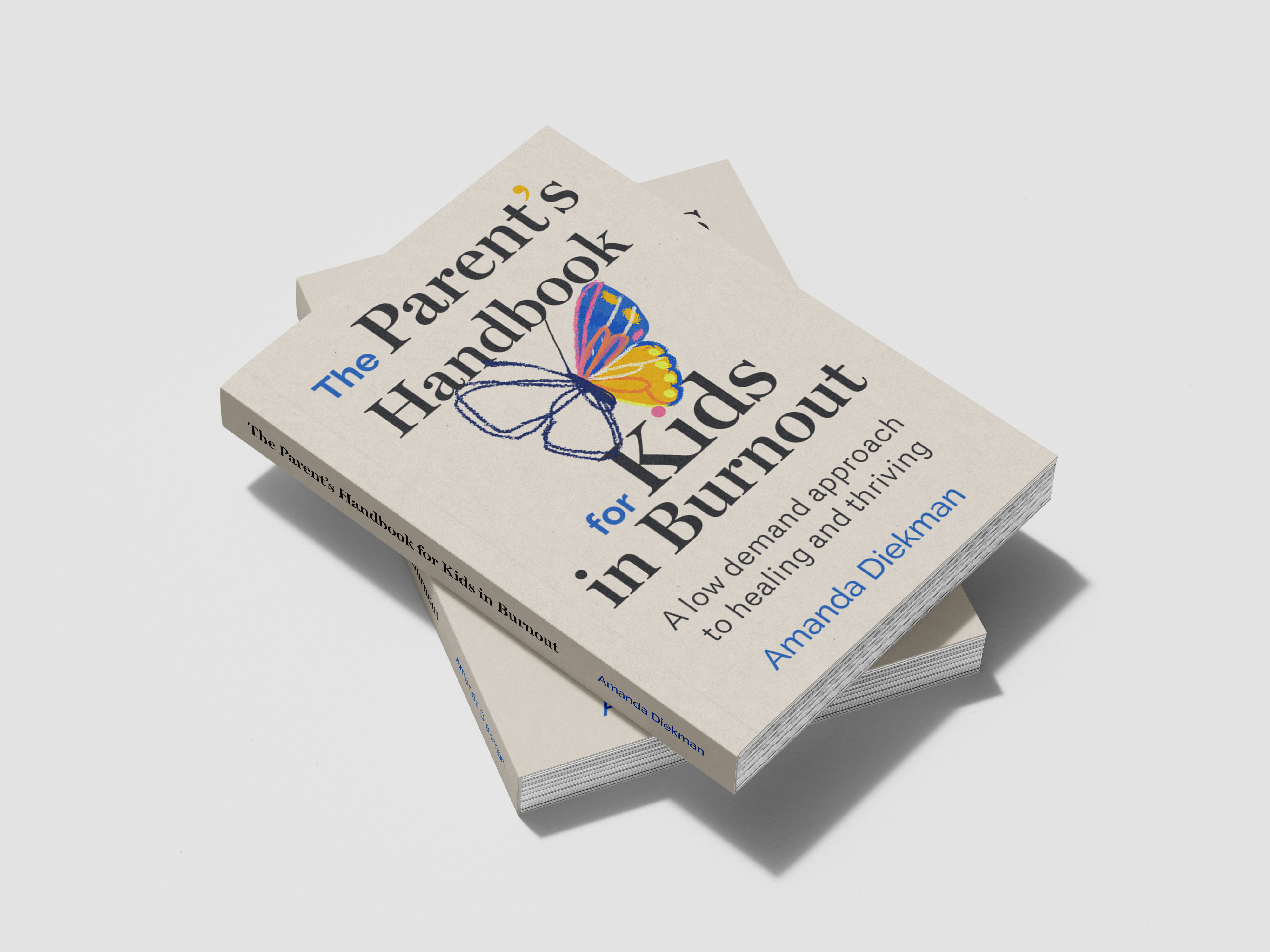 My newest book is here to help!
The Parent's Handbook for Kids in Burnout is a practical, research-driven resource to help you identify sources of stress and respond with compassion, while continuing to support your child’s growth and thriving.
With chapters to meet you wherever you’re at, this comprehensive handbook comes with a burnout assessment quiz, downloadable tools and charts, and dozens of practical stories and examples. Get the answers you need right away with chapters on showering, sleep, screens, school, meds, therapies, meltdowns, and mental health emergencies.
Quiz: "Why is everything so hard?"
................
Get your quiz results and discover one concrete next low-demand step toward ease and joy.
Low Demand in your Inbox
Juicy weekly emails include real-life parenting stories, low-demand ideas and tips, plus a collection of my favorite resources. A goodie-box of an email.
We hate SPAM. We will never sell your information, for any reason.